
Why the Best Real Estate Leads Aren't on Zillow—They're at the Currency Exchange
By the time a high-net-worth prospect sits down on their sofa and types "Luxury Condos for sale in West Vancouver" into Zillow or REW.ca, you have already lost the most critical advantage: Exclusivity.
At that exact moment, you are no longer the only option. You are instantly competing with fifty other developers, three aggressive algorithmic banner ads, and the overwhelming noise of the open market. You have entered a "Red Ocean" where the Cost Per Lead (CPL) is skyrocketing, ad blindness is high, and the user's attention span is fractured.
In the race for presale leads, most marketing agencies obsess over the "Search Phase." They burn budget bidding on keywords and fighting for SEO rankings.
But smart capital? Smart capital focuses on the "Preparation Phase."
For Vancouver’s affluent immigrant market—specifically the high-cap Persian demographic—the home buying journey doesn't start with a search query. It starts with a financial transaction. Before they browse listings, newcomers and investors visit currency exchanges to move the necessary capital.
If you aren't advertising at this "Point Zero" of the value chain, you are arriving late to the negotiation.
The "Hidden" Pre-Purchase Journey: The Liquidity Phase

To understand how to truly access the high-cap real estate market, you have to look beyond simple demographics. You have to understand logistics.
For a high-net-worth individual moving capital into Canada, the process is not casual. It is structured, high-stakes, and often stressful. Before a deposit on a presale condo can even be discussed, liquidity must be secured. This creates a unique, high-intensity window of opportunity we call the "Liquidity Phase."
This phase can last anywhere from a few days to a few weeks. Crucially, this journey is invisible to digital pixels. Google doesn’t know a wire transfer is happening. Facebook doesn’t know a bank draft is being prepared. But this activity is highly visible in the physical world.
The Trust Factor
The beauty of targeting this phase is that no language barrier is needed to understand the intent.
When someone is physically present in a currency exchange in North Vancouver, transferring significant funds, their intent is not "browsing." It is "transacting." They are in a serious state of mind. By placing your brand in this physical location—where the down payment is literally being processed—you are relying on verified financial behavior, not just vague browser cookies or "interests" inferred by an algorithm.
Following the Money: The Tech Advantage

In the Totemian network, Currency Exchanges represent one of our highest "Context Density" clusters.
But why does this specific environment work so well? It comes down to mindset. Unlike a coffee shop where the mindset is leisure, or a bus stop where the mindset is boredom, the mindset in an exchange is purely financial. The audience is focused on rates, numbers, and future investments.
Enter pDOOH: More Than Just a TV
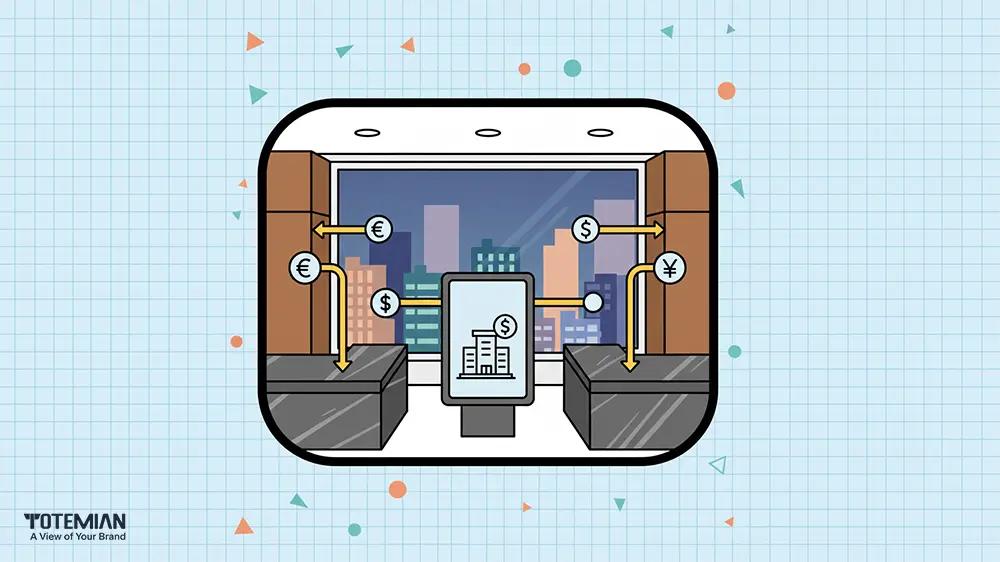
This is where our technology differentiates your campaign. Using pDOOH (Programmatic Digital Out of Home), we leverage this dwell time effectively. We don't just hang standard consumer TVs playing loop videos. We install high-definition, vertical Brandboards.
- The Content Match: A digital screen in an exchange isn't ignored. Why? Because we integrate API-driven content, such as real-time currency rates, directly onto the screen. The audience needs to look at our screen.
- The Subconscious Link: When we place a sleek, 4K render of your new Presale Project right next to those live financial rates, we create a powerful subconscious link between "capital" and "asset."
We aren't just putting a poster on a wall. We are inserting your real estate project seamlessly into the financial workflow of the buyer.
Why Zillow is Too Late: Capturing Intent at "Point Zero"

Digital platforms like Zillow are lower-funnel tools. By the time a user is there, they are in "Comparison Mode." They are looking for reasons to say "no" to your floorplan, your price per square foot, or your strata fees.
Currency Exchanges represent "Point Zero." The user is in "Acquisition Mode." They have the money, and they are looking for a place to put it.
By dominating the screens in the major currency exchanges across North and West Vancouver, you achieve two distinct strategic advantages:
- First-Mover Advantage: You introduce your development before the buyer is overwhelmed by MLS listings. You become the benchmark against which other properties are measured.
- Borrowed Authority: Your brand is seen in a trusted financial environment. If a buyer trusts the exchange with their life savings, and your brand is the dominant visual in that room, that trust transfers to your project.
It is the difference between asking for a sale (on Zillow) and offering an investment solution (at the Exchange).
Strategy in Action: The Math of Efficiency
Let’s look at the math. In advertising, "Reach" is vanity, but "Relevance" is sanity.
If you buy a mass-market billboard or a standard bus shelter ad, you are paying for "eyeballs." But whose eyeballs are they? Students? Tourists? People who just bought a home yesterday?
Let's break down the True CPM (Cost Per Relevant Mille):
- Traditional OOH (Bus Shelter): You pay to reach 10,000 people. Maybe 50 of them are actually in the market for a luxury home. That means 99.5% of your budget is wasted on people who cannot buy your product.
- Targeted pDOOH (Currency Exchange): You reach 500 people. But nearly all of them are engaged in cross-border financial activity, holding foreign currency, or executing high-value transactions.
The cost to reach one actual buyer in our network is significantly lower than mass media because the wastage is virtually eliminated. You aren't paying for the crowd; you are paying for the qualified few.
The Bottom Line
Stop chasing leads where the competition is fiercest. Stop shouting in the "Red Ocean" of search engines. Start meeting your buyers where their journey actually begins.
In the Totemian ecosystem, we don't just track foot traffic; we track the flow of value. If you want to see exactly where these high-net-worth hubs are located in North and West Vancouver, we have mapped them out for you.