
The "Wait Time" Goldmine: How to Convert Patients While They Wait
In the digital advertising world, we are in a state of crisis. The average human attention span has dropped to just 8 seconds—less than that of a goldfish.
Marketers are forced to cram complex value propositions into 3-second pre-roll ads and fleeting social media stories. For brands selling simple products like soda or sneakers, this might work.
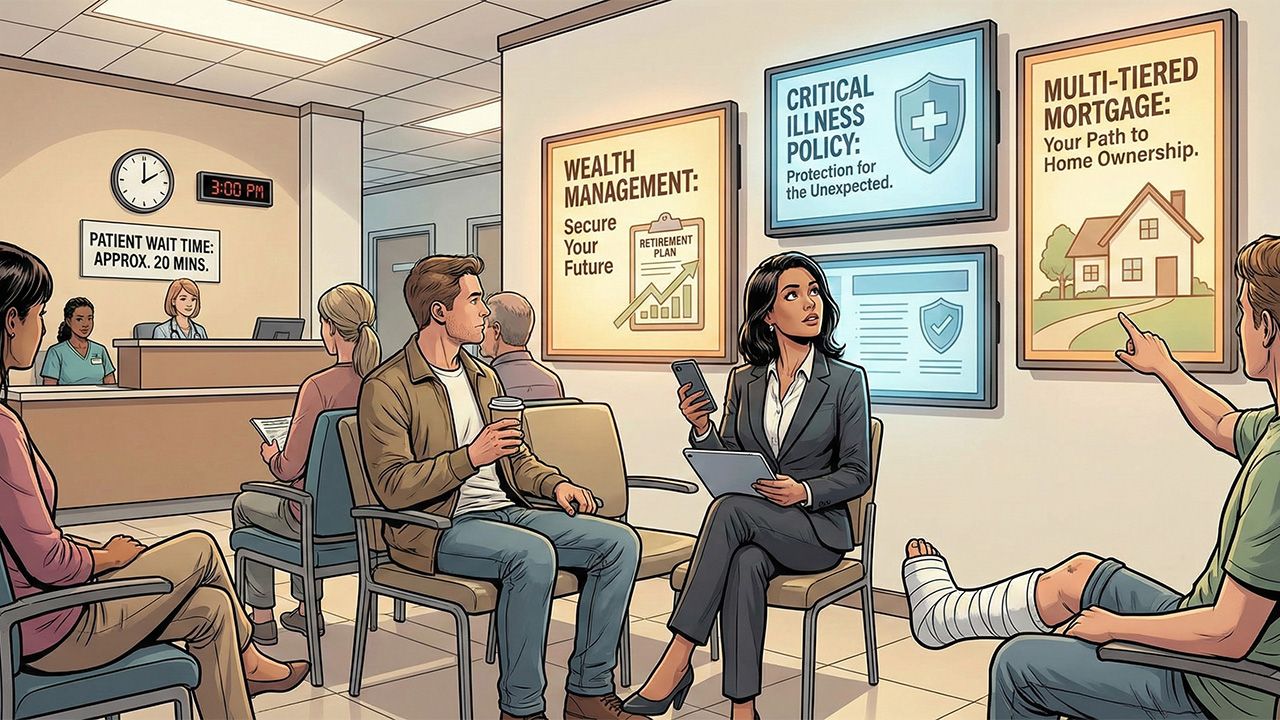
But what if you are selling something complex? What if you are a wealth management firm trying to explain a retirement plan, an insurance broker detailing the nuances of a critical illness policy, or a bank promoting a multi-tiered mortgage product?
You cannot explain trust, security, and long-term value in 8 seconds.
This is the fundamental disconnect of modern advertising: the most valuable products require the most education, yet we have the least amount of time to provide it.
But what if there was an untapped environment where the audience wasn't just scrolling, but sitting? Where you didn't have 8 seconds, but 15 minutes of their undivided attention?
Welcome to the "Wait Time Goldmine."
3 Seconds vs. 15 Minutes: The Physics of Attention
To understand the power of dwell time, you have to understand the two modes of modern media consumption: Active Scrolling vs. Passive Waiting.
The 3-Second World (Active Scrolling)
When a user is on their phone scrolling through Instagram or TikTok, they are in a state of "Active Discovery." They are the hunter. They are in control. Their thumb is constantly moving, ready to flick away anything that doesn't provide an instant dopamine hit. In this world, your ad is an intruder. It is an interruption to their flow, and they are biologically wired to ignore it. The best you can hope for is a fleeting glance.
The 15-Minute World (Passive Waiting)
Now, consider the environment of a medical clinic, a high-end dental office, or a busy pharmacy. The average Dwell Time in these waiting rooms is between 15 and 20 minutes.
The user is no longer the hunter. They are waiting. Their phone battery might be low, or they may simply be looking for a passive, low-effort distraction. They are in a state of "Passive Receptivity." Their cognitive shields are down because they are not actively fighting for control of their feed. This is the "Social Mode" in its purest form—a relaxed state where the brain is open to new information.
In this environment, a high-definition digital screen is not an interruption; it is a welcome diversion. It is a source of information and entertainment in a moment of boredom. This shift from a 3-second battle to a 15-minute conversation is the single greatest opportunity for marketers of complex services.
Turning "Dead Time" into "Learning Time"

For decades, the waiting room has been considered "Dead Time." It's a logistical necessity, a boring void filled with outdated magazines and generic news channels that often contribute to anxiety.
But with smart digital signage, this "Dead Time" can be transformed into "Learning Time."
This is where Contextual Education comes into play. You aren't just showing an ad; you are providing value to the viewer while they have the mental bandwidth to absorb it.
Think about the mindset of a person in a pharmacy waiting for a prescription. They are thinking about their health, their family's well-being, and their future. This is the perfect psychological moment to introduce a complex but relevant topic.
- The Problem: An insurance ad on TV feels aggressive and salesy.
- The Solution: Instead of a long commercial, imagine a "Micro-Learning" series on a clinic's Totemian Brandboard. Over the course of their wait, the patient sees three separate, 15-second animated tips, each one explaining a key part of a family health plan. It feels like helpful advice, not a sales pitch.
You are moving from "selling" to "advising."
Best Content Strategies for Pharmacy & Clinic Screens
To win in the "Wait Time Goldmine," your content cannot be a repurposed TV commercial. It needs to be designed for the unique psychology of the waiting room.
Here are three proven strategies:
A. The "Problem-Solution" Loop (Educational Content)
The most effective content in these spaces is educational. It identifies a common anxiety and offers a clear, simple solution.
- For a Bank: A short animated video showing the difference between a TFSA and an RRSP.
- For an Insurance Broker: A graphic explaining "Why renter's insurance costs less than your daily coffee."
- For a Wealth Manager: A chart showing the power of compound interest over time.

B. The "Silent Story" (Visually-Driven Content)
Most waiting rooms are quiet. Your content must work without sound.This means relying on:
- Large, Clear Typography: Key messages must be readable from across the room.
- High-Quality Visuals: Use cinematic video and professional graphics to hold attention.
- On-Screen Captions: Every video must have burned-in subtitles.
C. The "Trust Transfer" (Co-Branding)
When your ad for a financial product appears on a screen inside a trusted doctor's office or pharmacy, you benefit from "Borrowed Authority." The credibility and professionalism of the medical environment subconsciously transfer to your brand. By sidestepping the digital "Black Box" of anonymous ads, you become a trusted partner of a place they already respect.
How to Sell Complex Services Without Being Pushy
The ultimate goal is to generate a lead without ever feeling like you are "selling."The strategy is to "Plant the Seed, Don't Force the Harvest."
Instead of a "Call Now!" CTA, which feels urgent and out of place, use a "Soft CTA" that encourages curiosity and further research.
- Good CTA: "Scan the QR code to download our free guide to 'First-Time Home Buyer Mortgages'."
- Better CTA: "Ask your pharmacist about insurance plans that cover this prescription." (Leveraging the on-site authority).

The goal of the ad is not to close the deal. The goal is to start the conversation by making a complex topic feel simple and accessible.
The Last Frontier of Undivided Attention
As the digital world becomes more fragmented and chaotic, the quiet, controlled environment of the waiting room has become the last frontier of undivided attention.
You can continue to spend your marketing budget fighting for 3-second views on a crowded social media feed, or you can start having a 15-minute conversation with a captive, receptive, and high-value audience.

The technology to do this effectively exists. Totemian's network of Pharmacy & Medical Centers is not just a collection of screens; it is an ecosystem designed for long-form attention. We provide Brandboards, the data analytics, and the strategic expertise to turn "wait time" into your most profitable marketing channel, delivering an unmatched "True CPM" because every viewer is relevant.
Are you ready to stop interrupting and start educating?